Build Your English Speaking Confidence
A four-hour, hands-on seminar for professionals with strong English who want to communicate with the confidence their expertise deserves.
The workshop focuses on habits that can weaken confident delivery in English. Among them are: transferring sentence patterns from another language, overusing hedging words, and ending statements with rising intonation. Participants learn to communicate clearly under pressure and practice using real workplace situations, including meetings, pitches, calls, and presentations.
- Format
- A four-hour workshop centered on practical speaking exercises.
- Group
- Designed for groups of up to 12 participants.
- ideal for
- Professionals and teams who communicate in English with American colleagues, clients, and partners.
- Level
- A solid working command of English.
- Method
- Each module combines a concise explanation, a live demonstration, and paired speaking practice. Participants record themselves at the beginning and end of the seminar so they can hear their progress.
- Delivery
- Available in person or via Zoom.
- Language of Instruction
- Instruction is available in Hebrew or English, with all speaking practice conducted in English.
- Before the seminar
- Each participant completes a five-minute questionnaire and brings one real workplace situation to practice during the seminar.
- After the seminar
- Participants receive a quick-reference guide and a structured 30-day practice plan.
For Professionals Ready to Make Their English Reflect the Full Strength of Their Expertise and Confidence.
- Executives and managers who lead meetings with American colleagues, vendors, and board members.
- CEOs, CROs, VPs of Sales, and other revenue leaders who deliver pitches and lead calls with American customers.
- Founders pitching to American investors.
- Professionals who present to American leadership teams or large audiences.
- Professionals reentering the workforce after relocating to the U.S.
- HR and L&D leaders seeking practical communication training for their teams.

Inside the Four-Hour Seminar
The four-hour seminar includes approximately 215 minutes of instruction and practice, plus two 10-minute breaks. Each habit is explored through four steps: what it is, why it happens, how it affects communication, and how to change it through spoken practice. Participants bring one real workplace situation to develop throughout the session, recording themselves at the beginning and end to hear their progress.
Welcome and Starting Point
Meet the participants, understand their goals, and preview what the seminar will cover.
- Participants reflect on how their confidence and communication style change when they speak English.
- The typical participant has strong English and follows every conversation, yet leaves meetings feeling that their expertise, authority, or personality did not fully come through.
- Each participant selects one recurring workplace situation, such as a pitch, board update, vendor call, or interview, and develops it throughout the workshop.
- An introduction to the three communication habits and the plan for the session.
Why Confidence Gets Lost in English
Speaking habits often have a greater impact on perceived confidence than vocabulary, grammar, or accent.
- Why Strong English Can Still Sound Less Confident
- Patterns from your first language can carry into English without conscious awareness. What signals politeness, modesty, or cooperation in one language may be heard as hesitation in English.
- The stronger your English becomes, the more noticeable subtle confidence gaps can become.
- "Language is power, and here, I don't have that power." A senior marketing executive after relocating to New York.
- A certified coach who works with American executives described the experience this way. "Sometimes I feel as if I'm scratching, fighting, and constantly reaching forward."
- Each participant records a 60-second response to their chosen workplace situation, then revisits it at the end of the seminar to measure their progress.
Habit 1 | English Shaped by Your First Language
See how the same idea changes when expressed through different language structures.
- Watch a live comparison between "I think maybe we could try to do it differently" and "My recommendation is to change the approach," and hear how sentence structure changes perceived confidence and authority.
- Many languages signal politeness through qualifiers such as "maybe" and "I think." In American business English, politeness can often be built into the sentence structure, keeping the message both clear and respectful.
- Too many qualifiers can make a well-developed idea sound uncertain and turn a recommendation into a request for approval.
- A fintech manager overseeing American vendors found that when a vendor pushed back, complex ideas came out oversimplified in English.
- Rewrite five sentences from your own work using position-first structures such as "My recommendation is...," "I propose...," and "The next step is...," then practice delivering them aloud.
Habit 2 | Overusing Fillers and Hedge Words
Understand how different hedge words shape the way others interpret your confidence and commitment.
- A practical guide shows how common hedges may be received when overused. "Maybe we could" can sound hesitant, "kind of" imprecise, "I'm not sure, but" uncommitted, and "I don't know if" uncertain.
- Hear a live demonstration of what happens when multiple hedges weaken a message. "I was thinking maybe we could kind of try to look at this differently. I don't know. It's just an idea..."
- For speakers from cultures where directness signals respect, communicating in English can prompt extra softening. Filler words and hedges often appear as a result.
- Overused hedges can dilute the message that follows, making strong ideas sound less convincing.
- Practice confident softening with phrases such as "May I suggest...?", "I appreciate your input. I'd like to propose...," and "I see a few potential challenges with this approach."
- Work in pairs and speak about your work for two minutes while your partner tracks each hedge. Then repeat the exercise, replacing unnecessary hedges with clear, confident language.
Habit 3 | Rising Intonation on Statements
A rising tone can make a confident statement sound uncertain.
- Rising intonation at the end of a sentence can make a statement sound like a question.
- In some languages, rising intonation can still signal a firm statement. In English, "So the meeting is at three?" usually sounds like a request for confirmation.
- We hear our intention. Others hear our delivery.
- In a pitch, performance review, or board meeting, rising intonation can make you sound uncertain about your own position.
- A New York construction company owner found that deals that should have closed in one meeting were taking four.
- Hear "My recommendation is to move forward" delivered with both falling and rising intonation, and compare how each version is received.
- Practice delivering the same sentences with rising and falling intonation while your partner notes how each version sounds. Then record yourself, play it back, and assess the difference.
Confident English Under Pressure
Learn how to maintain clear, confident English when someone challenges your position.
- Under stress, English can become simpler and more abrupt as speakers fall back on familiar, direct phrasing.
- Distinguish between a pause used to search for a word and a deliberate pause used for emphasis, and learn how listeners interpret each one.
- Understand the difference between passive and active vocabulary, and why knowing a word does not always mean finding it when you need it.
- American listeners may nod and move on rather than say that they did not fully understand, making clarity checks especially valuable.
- Work in pairs on a pushback drill. Your partner challenges your recommendation with three prepared objections, and you respond using clear structure, falling intonation, and minimal hedging.
How Word Choice Signals Authority
Learn how word choice can signal confidence, expertise, and seniority before the full message is heard.
- Compare how word choice shifts tone from conversational to formal, such as "big" and "significant," "think about" and "consider," or "Can you help me?" and "I'd value your input."
- Build a toolkit for holding your position with clarity and diplomacy. Useful phrases include "I see this differently. In my experience...," "I understand your perspective, and I'd like to offer another," "The data we've collected suggests...," and "Have we considered how this might affect our timeline?"
- Use "aggressively polite" communication to state your position clearly while keeping the conversation open and constructive.
- Rewrite five phrases from your own emails and meetings to make them clearer, more confident, and more effective.
Confident Presence and Delivery
Use pace, intentional pauses, and a strong opening line to establish confidence from the start.
- Explore how eye contact, gestures, pace, and pauses shape the way your message is received.
- Learn how to open with confidence and use deliberate pauses to give your message greater impact.
- Use active listening to strengthen your presence and make conversations feel more confident and connected.
- Deliver a 60-second opening for your chosen workplace situation and receive targeted feedback on your first line, pace, and pauses.
Putting It All Together
Bring every technique together in one final practice round.
- Each participant delivers a two-minute version of their chosen workplace situation and receives focused feedback from the group.
- Compare the baseline recording with the final version to hear the progress clearly.
- Create a personal 30-day action plan focused on one communication habit and a clear strategy for practicing it.
- Your Questions and Next Steps
Speak clearly, if you speak at all; carve every word before you let it fall.
Practical Tools and Habits You Can Apply Immediately
- The ability to recognize the three habits in your own speech.
- A clear, position-first structure for delivering recommendations, proposals, and updates.
- Techniques for building politeness into your sentence structure without relying on unnecessary hedge words.
- Greater control of falling intonation through focused spoken practice.
- Strategies for maintaining clear, confident English during pushback and fast-paced calls.
- Word choices that reflect your expertise and suit the professional context.
- Before-and-after recordings of your chosen workplace situation so you can hear your progress.
- A personalized 30-day practice plan focused on the habit that most affects your communication.
Before, During, and After Every Seminar
Pre-seminar questionnaire
Each participant completes a five-minute questionnaire before the seminar. Their responses help us select relevant examples and organize effective practice pairs.
- The real workplace situations in which each participant communicates in English.
- The moments when their confidence or expertise may not come through fully, such as opening a meeting, explaining a complex idea, handling live questions, responding to pushback, or closing a conversation.
- One real workplace situation for each participant to develop and practice throughout the workshop.
Before-and-After Recordings
Each participant records their chosen workplace situation on their phone at the beginning and end of the workshop, then keeps both recordings to track their progress.
Quick-Reference Guide
A one-page guide to keep and use after the seminar.
- A clear summary of the three communication habits and practical techniques for changing each one.
- Common hedge words and clear, confident alternatives to use in their place.
- Ready-to-use opening phrases for clear, position-first statements.
- Professional word choices and practical phrases for holding your position with diplomacy.
Personalized 30-Day Practice Plan
A concise, self-guided practice plan delivered by email or provided as a PDF.
- The communication habit that will make the greatest immediate difference.
- A focused five-minute speaking exercise for daily practice.
- A weekly self-recording to compare with your original baseline.
Optional Follow-Up Coaching
Each participant may book a complimentary 30-minute communication assessment. Those seeking continued support can join EasyTalk's monthly, one-on-one coaching program.
What to Expect Throughout the Seminar
Initial Consultation
We confirm the seminar date, delivery format, and participant list of up to 12 people.
Pre-Seminar Questionnaire
Each participant completes a five-minute questionnaire 5 to 7 days before the workshop and selects one real workplace situation to practice.
The seminar
Four hours of focused practice, with a baseline recording at the beginning and a final version at the end to demonstrate progress.
After the seminar
Each participant receives a quick-reference guide and a personalized 30-day practice plan, with the option to book a complimentary communication assessment.
Key Details About the Format, Preparation, and Participation.
What level of English do I need?
You should have a solid working command of English and use it regularly at work. The seminar is designed for professionals whose confidence and expertise do not always come through fully when they speak.
Does the seminar teach grammar or vocabulary?
The workshop focuses on how your English sounds and how your message is received, including sentence structure, hedge words, intonation, word choice, and delivery.
Can the seminar be delivered in Hebrew?
Yes. Instruction is available in Hebrew or English, with all speaking practice conducted in English.
Is the seminar available in person and on Zoom?
Both formats are available. In either setting, participants practice in pairs and record their progress.
How should I prepare?
Complete the five-minute questionnaire and bring one real workplace situation, such as a pitch, update, vendor call, or interview.
What happens after the seminar?
You keep the quick-reference guide, personalized 30-day practice plan, and both recordings. You may continue with a complimentary 30-minute communication assessment.
Other services
Cross-Cultural Communication Workshop
A 4-hour, hands-on workshop for companies and organizations that work with Americans. Participants learn how American communication works and apply it to real workplace situations, including meetings, emails, feedback, and building trust with U.S. partners. Delivered on-site or via Zoom to groups of up to 15.
Read more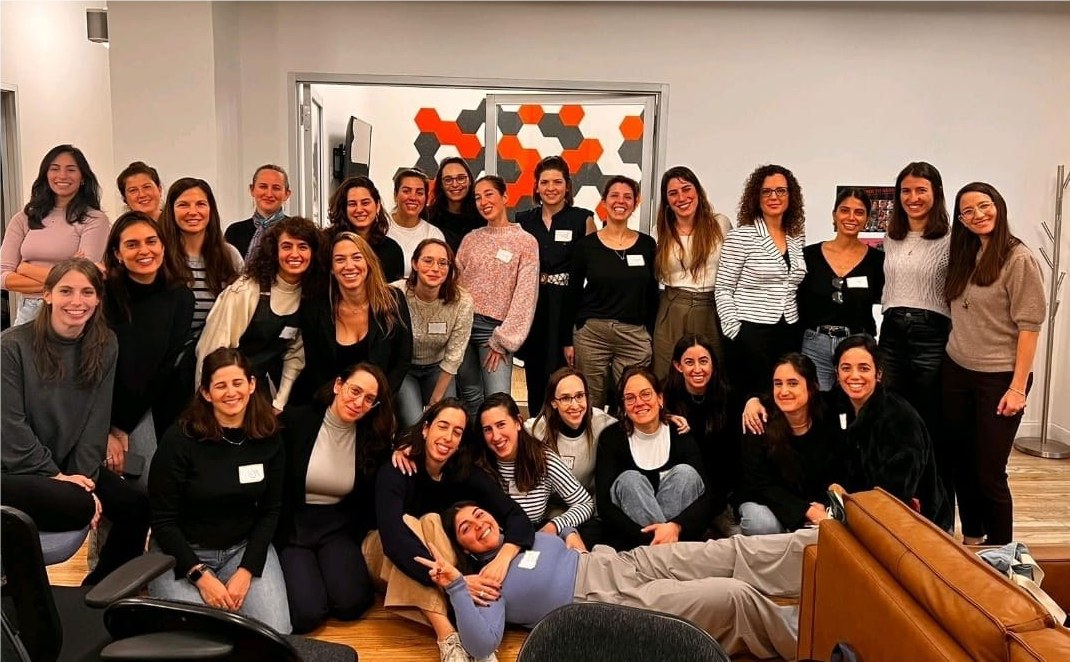
English Groups for Teams
Live, small-group English courses for employees, delivered via Zoom by experienced native English-speaking instructors. Groups of up to 6 are matched by proficiency level, and the 20-session course covers meetings, emails, customer communication, presentations, and negotiations.
Read more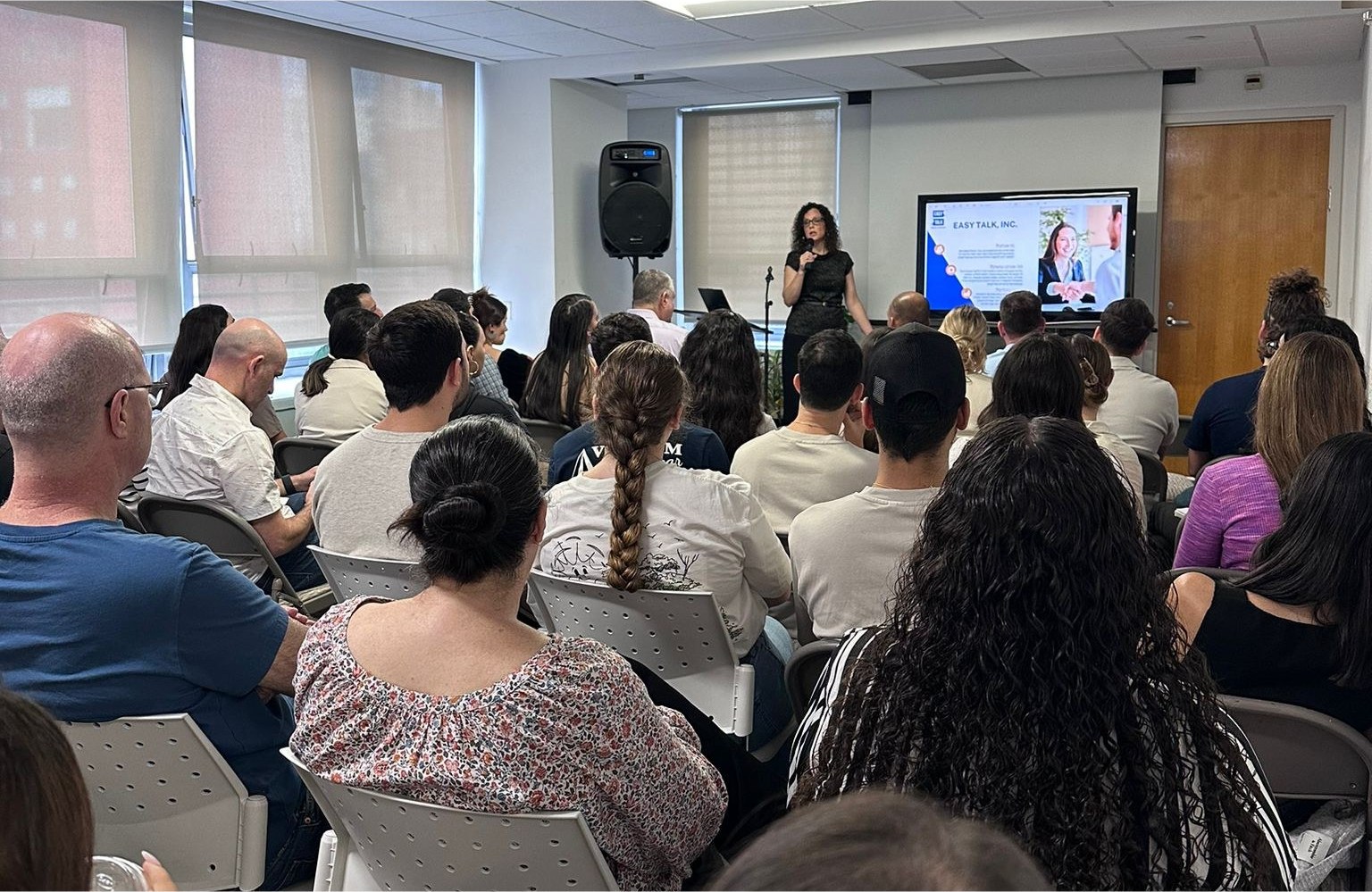
Hebrew Groups for Teams
Hebrew courses for employees who work with Israeli colleagues, head office teams, and clients, in small groups of up to 6 placed by level. There are twenty 55-minute sessions on Zoom with native Hebrew-speaking instructors, for all levels from true beginners to advanced, with private sessions available for an accelerated track.
Read moreTailor-Made Program
A training program designed around your people, their real workplace situations, and the results you want to achieve. Beginning with a program-mapping call and a short participant assessment, we combine workshops, group courses, one-on-one coaching, and keynote sessions into a single plan.
Read more
One-on-One Coaching
One-on-one coaching via Zoom with a professional native English-speaking instructor, tailored to your role, goals, and real communication needs. Our method helps you formulate ideas directly in English instead of translating them from your first language.
Read more
Job Interview Prep in English
One-on-one interview coaching in English, tailored to the role you want. You develop clear answers from your own professional experience, prepare for the questions you are most likely to hear, and practice timed mock interviews followed by focused feedback. Programs include 6 to 12 hours of coaching, scheduled around your interview date.
Read more
English For English-Speaking Kids
A complimentary guide and small online groups that help children maintain their English active and confident and continue growing it, whether they learned it abroad or speak it at home in a non-English-speaking country. Through conversation, age-appropriate activities, and supportive friendships, English becomes a natural part of their lives.
Read more
Easy Talk Webinars
Free live webinars with Yael Elkarat on English and American culture, at work and at home. Each webinar addresses a question our clients ask often, with real examples. Leave your name and email, and we will notify you when the next webinar is scheduled.
Read more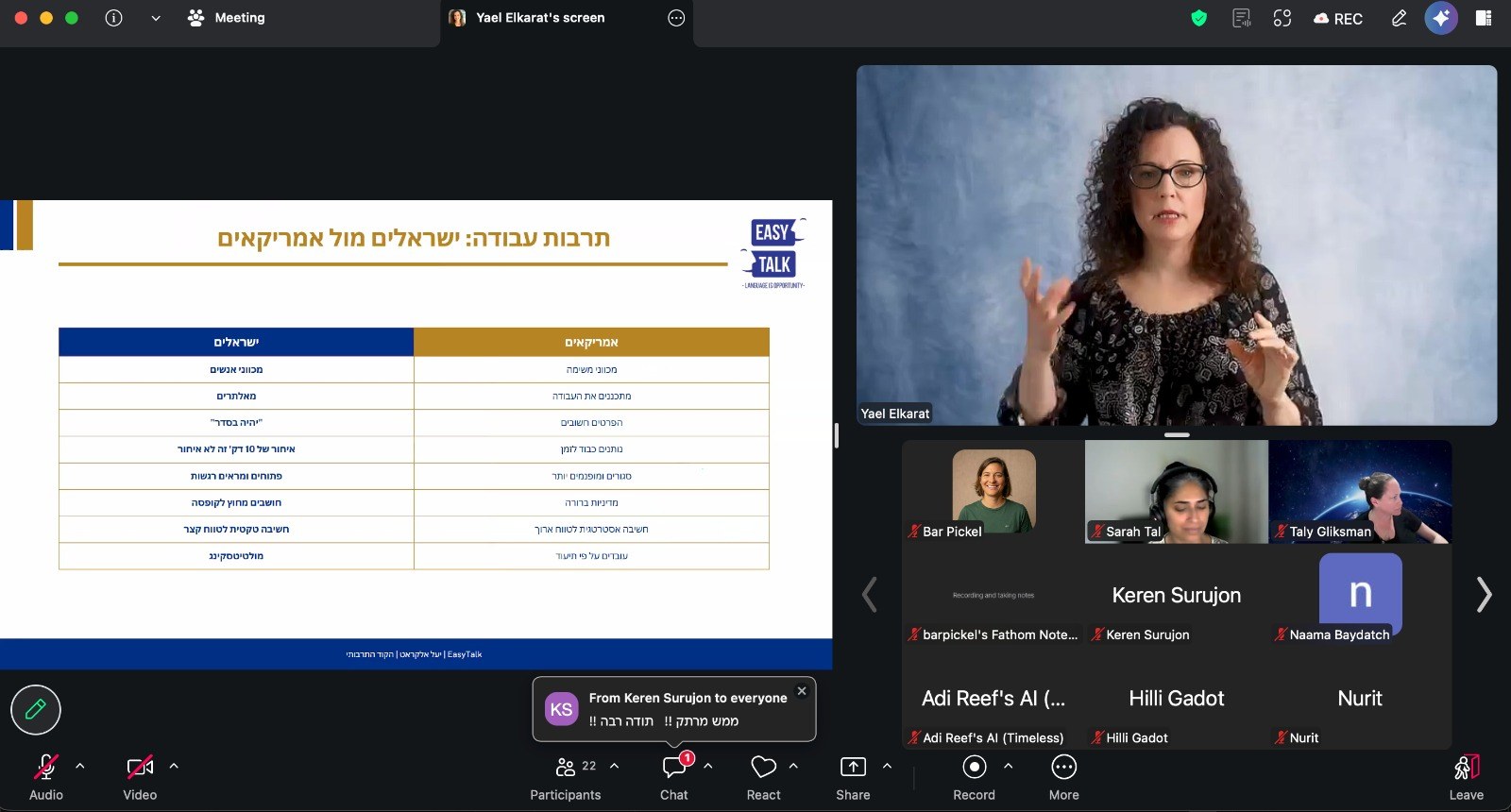
Tell Us About Your Goals and
We'll Recommend the Right Program
Share your language training challenges. We'll recommend the right format and create a plan tailored to your goals.
Opens the calendar here on the page
Tel Aviv · New York · Virtual worldwide
Request a Consultation
Thank you
We have it, and you will hear back within a business day.